
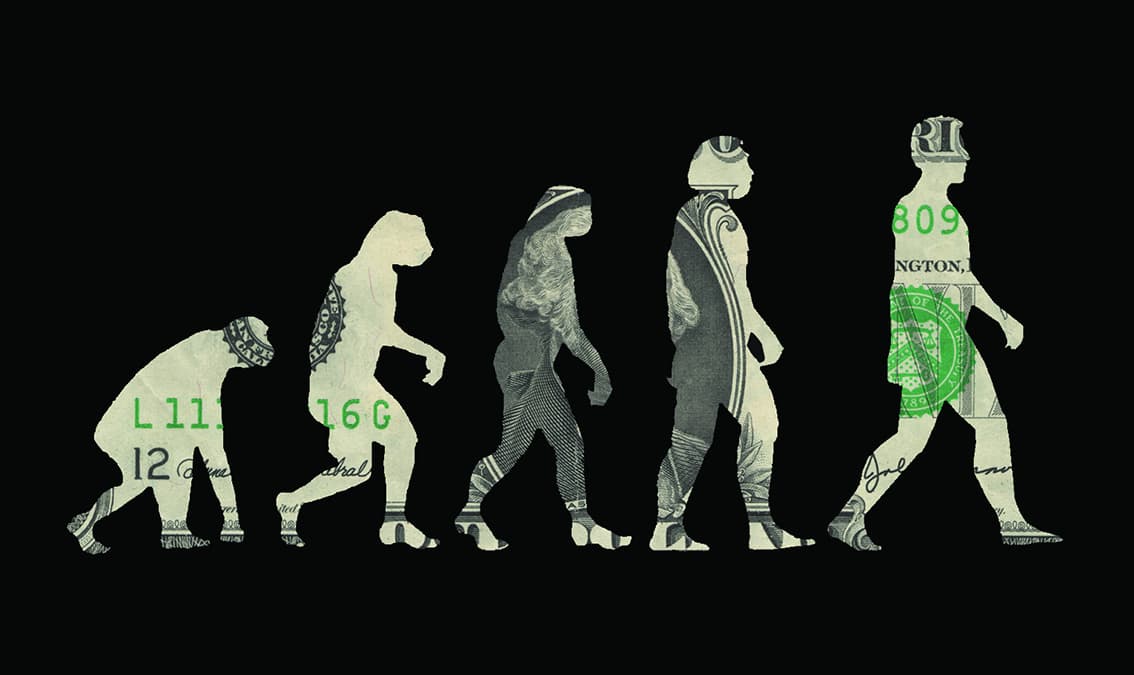
Adaptive Markets: Financial Market Dynamics and Human Behavior
Massachusetts Institute of Technology
A completely new way of thinking about financial markets, institutions, and innovation that reconciles human behavior with market efficiency using concepts from evolutionary biology, cognitive neuroscience, and artificial intelligence.
About this Course
Half of all Americans have money in the stock market, yet economists can’t agree on whether investors and markets are rational and efficient, as modern financial theory assumes, or irrational and inefficient, as behavioral economists believe—and as financial bubbles, crashes, and crises suggest. This is one of the biggest debates in economics, and the value or futility of investment management and financial regulation hang on the outcome. In this course, MIT finance professor Andrew W. Lo cuts through this debate with a new framework—the Adaptive Markets Hypothesis—in which rationality and irrationality coexist. Drawing on psychology, evolutionary biology, neuroscience, artificial intelligence, and other fields, this course shows that the theory of market efficiency isn’t wrong, but merely incomplete. When markets are unstable, investors react instinctively, creating inefficiencies for others to exploit. This new paradigm explains how evolution shapes behavior and markets at the speed of thought—a fact revealed by swings between stability and crisis, profit and loss, and innovation and regulation. A fascinating intellectual journey filled with compelling stories, the course begins with the origins of market efficiency and its failures, turns to the foundations of investor behavior, and concludes with some practical implications—including how hedge funds have become the Galápagos Islands of finance, what really happened in the 2008 meltdown, and how we might avoid future crises. This course provides ambitious new approaches to address some of the biggest challenges facing us today such as cancer, climate change, the energy crisis, and how to navigate through the choppy waters of global financial markets in a post-COVID-19 world. --- Please note: edX Inc. has recently entered into an agreement to transfer the edX platform to 2U, Inc ., which will continue to run the platform thereafter. The sale will not affect your course enrollment, course fees or change your course experience for this offering. It is possible that the closing of the sale and the transfer of the edX platform may be effectuated sometime in the Fall while this course is running. Please be aware that there could be changes to the edX platform Privacy Policy or Terms of Service after the closing of the sale. However, 2U has committed to preserving robust privacy of individual data for all learners who use the platform. For more information see the edX Help Center . 3b:T167b,{"@con
What You'll Learn
- Limits to rationality and market efficiency, and the adaptive nature of markets
- Psychlogical, neuroscientific, and evolutionary foundations of human behavior
- Formulation of the Adaptive Markets Hypothesis (AMH)
- Applications of the AMH to hedge funds, the 2008 Financial Crisis, and COVID-19
- Ethical implications and high-impact applications of the AMH
Instructors
Andrew W. Lo
Professor,
Zied Ben Chaouch
TA and PhD Student, Laboratory for Financial Engineering