
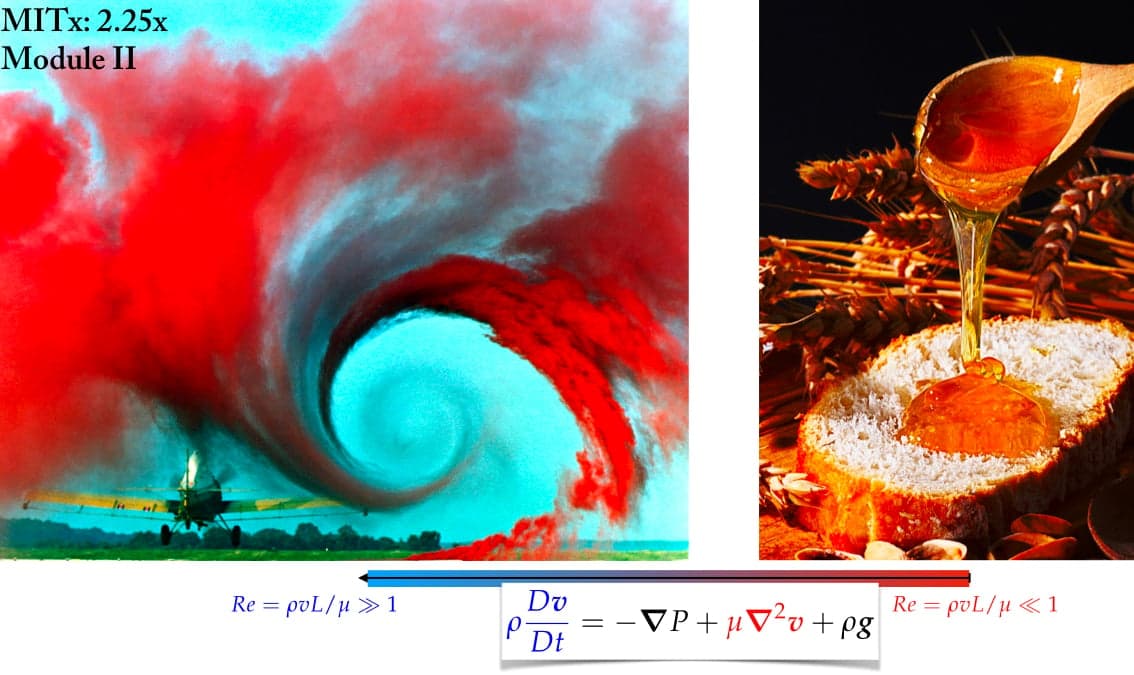
Advanced Fluid Mechanics 2: The Navier-Stokes Equations for Viscous Flows
Massachusetts Institute of Technology
Learn to apply the Navier-Stokes equations to viscous-dominated flows; including pipe flows, channel flows and free surface flows, use dynamical similarity and dimensional analysis, Stokes flows, similarity solutions and transient responses, lubrication analysis and surface tension.
About this Course
This course covers the Navier-Stokes equations for viscous flows: including pipe flows, channel flows and free surface flows, dynamical similarity and dimensional analysis, Stokes flows, similarity solutions and transient responses, lubrication analysis and surface tension. This course features lecture and demo videos, lecture concept checks, practice problems, and extensive problem sets. This course is the second of a three-course sequence in incompressible fluid mechanics consisting of Advanced Fluid Mechanics 1: Fundamentals; Advanced Fluid Mechanics 2: The Navier-Stokes Equations for Viscous Flows, and Advanced Fluid Mechanics 3: Potential Flows, Lift, Circulation & Boundary Layers. The series is based on material in MIT’s class 2.25 Advanced Fluid Mechanics, one of the most popular first-year graduate classes in MIT’s Mechanical Engineering Department. This series is designed to help people gain the ability to apply the governing equations, the principles of dimensional analysis and scaling theory to develop physically-based, approximate models of complex fluid physics phenomena. People who complete these three consecutive courses will be able to apply their knowledge to analyze and break down complex problems they may encounter in industrial and academic research settings. The material is of relevance to engineers and scientists across a wide range of mechanical chemical and process industries who must understand, analyze and optimize flow processes and fluids handling problems. Applications are drawn from hydraulics, aero & hydrodynamics as well as the chemical process industries. 3b:T
What You'll Learn
- The Navier-Stokes equation and appropriate boundary conditions
- The concept of Dynamical similarity
- Application of Dimensional analysis to complex problems
- Analysis of complex viscous flows such as Stokes flows or transient responses
- Lubrication Analysis for thin films and free surfaces
Prerequisites
- Comfort with undergraduate-level fluid mechanics, multivariable calculus and undergraduate differential equations: elementary vector and tensor manipulation, Fourier transforms, solving second order linear ODEs and PDEs. Students without this background will find there is a steep learning curve and may have to put in more than the estimated time effort.Note: this module (2.25.2x) is designed to be stand-alone. You do not need to take the first module (2.25.1x) to successfully complete this module.
Instructors
Gareth McKinley
School of Engineering Professor of Teaching Innovation
Bavand Keshavarz
Lecturer
John Liu
Lecturer, Department of Mechanical Engineering
Emily Welsh
Educational Technologist