
Human-Computer Interaction II: Cognition, Context & Culture
The Georgia Institute of Technology
Get into the user’s mind and understand the role of mental models and representations, then investigate how to design interfaces that integrate with and influence the world around us.
About this Course
This course takes you through lessons 9 through 13 of CS6750: Human-Computer Interaction as taught in the Georgia Tech Online Master of Science in Computer Science program. In this course, you’ll expand the scope through which you view human-computer interaction. You’ll start by going further inside the user’s mind to understand the role of mental models in guiding a user’s interaction with your system. A good user interface designer understands the mental models of their users and how representations can be used to correct those mental models. You’ll then learn methods for breaking down user behavior into more objective, discernible, and measurable chunks. Through the principles of task analysis and with artifacts like GOMS models, you’ll discover how to take the often-ethereal patterns of human interaction and distill them into externalizable, manipulable chunks. You’ll also learn how to use these artifacts to inform the design and improvement of interfaces. You’ll then widen your view to look at the context in which your interfaces are deployed. You’ll begin by learning about distributed cognition, which includes the notion that humans may offload cognitive tasks onto interfaces, and that humans and interfaces together may be considered higher-level cognitive systems. You’ll also learn about theories for investigating interaction in context, such as activity theory and situated action, and the role that human improvisation plays in any interface we design. Through these lenses, you’ll be equipped to design not just user interfaces, but user experiences developed with an understanding of the context around the interaction. You’ll conclude by expanding your view even further to investigate how interfaces interact with society itself: both how society guides the interfaces we create, and how the interfaces we create affect society. You’ll learn how interface design can be used to address societal issues, but also how it can have danger unintentional side effects. By the end of the course, you’ll have a deeper understanding of how human cognition interacts with user interfaces, and how user interfaces in turn interact with the world. You’ll be able to design interfaces that consider what the user knows and what is going on around the user. 3b:T17b8,{"@context":"https://
What You'll Learn
- The role of mental models in guiding human interaction with user interfaces.
- The role of representations in informing the development of accurate mental models.
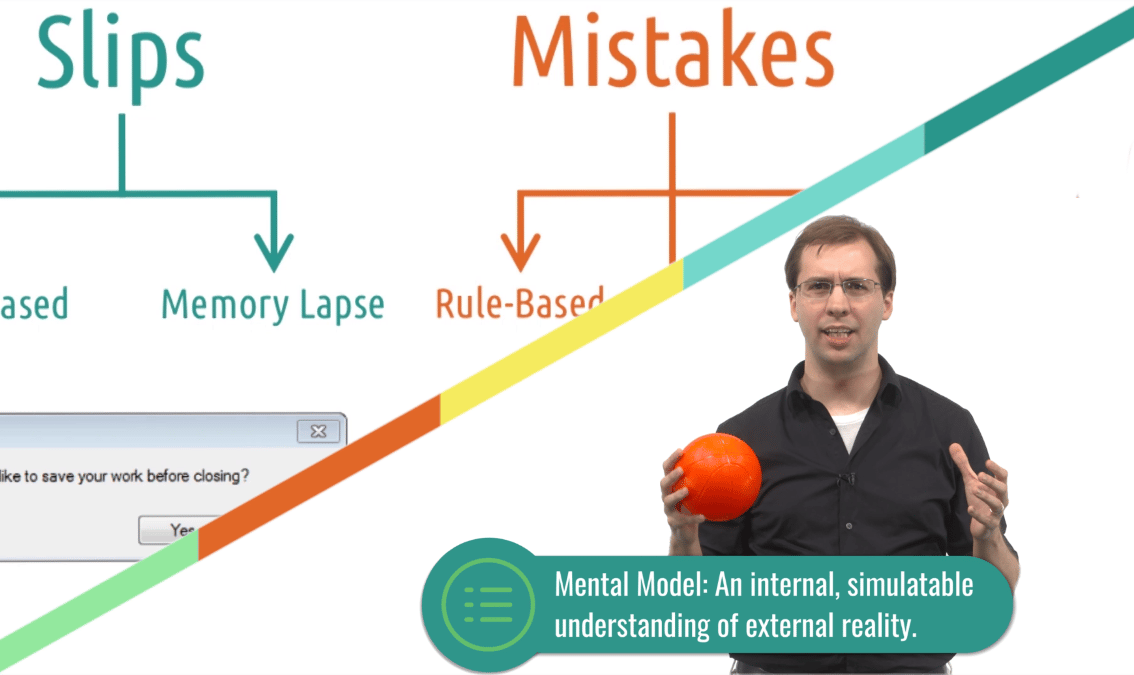
- The sorts of errors, slips, and mistakes humans are prone to and how to address them.
- Learned helplessness, and how to avoid it.
- Methods for decomposing human interaction into manipulable chunks.
- GOMS models for articulating user interaction with a system.
- Hierarchical task analysis for understanding assumptions about human knowledge and ability.
- Distributed cognition for designing larger systems comprised of humans and interfaces.
- Situated action for investigating and anticipating human behavior in context.
- An understanding of how society affects the designs we create.
- A view of how design can be used to address societal problems.
Instructors
David Joyner
Executive Director of Online Education & OMSCS | Principal Research Associate | Zvi Galil PEACE Chair