
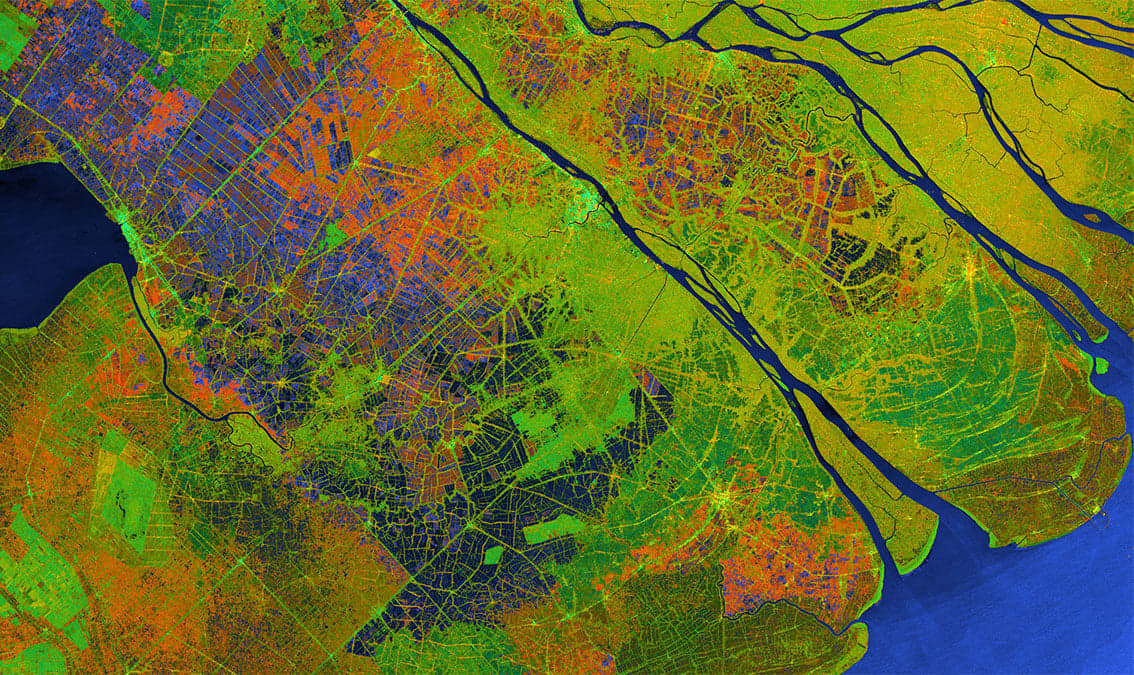
Synthetic Aperture Radar: Hazards
University of Alaska Fairbanks
This online course focuses on the applications of Synthetic Aperture Radar (SAR) remote sensing for disaster monitoring. Learn about weather and illumination-independent SAR remote sensing technology, and explore its applications to natural hazards including earthquakes, volcanic eruptions, and flooding.
About this Course
Remote sensing observations from airborne and spaceborne platforms have become an essential tool in disaster management. They provide an immediate and large-area overview of evolving disaster situations, revealing important hazard information to disaster response personnel. This course will introduce you to Synthetic Aperture Radar (SAR), a remote sensing technology that can see the earth surface even during darkness and through rain, clouds, or smoke. As a participant in this course, you will gain an intuitive understanding of the information contained in SAR earth observations and learn to use a range of analysis techniques and algorithms to apply SAR data to disaster mapping and management. Specific topics will include: The mathematical and physical principles of SAR remote sensing How to access and visualize SAR data Interpretation of SAR imagery in the context of disaster monitoring Interferometric SAR (InSAR) concepts Flood mapping and SAR change detection for hazard analysis InSAR-based analysis of volcanoes and landslides The learned concepts will be put into action in simulated disaster response exercises, in which class participants will analyze SAR data sets to create hazard information for several real-life disaster events from the recent past. Learners registered for the verified track will additionally get the opportunity for hands-on lab exercises using Jupyter Notebooks. The verified track will also include peer discussions and a verified certificate upon successful completion. This course is produced by the Alaska Satellite Facility at the University of Alaska Fairbanks, which has been selected as the NASA data hub for the upcoming NISAR mission.
What You'll Learn
- Intuitive understanding of SAR image and phase information
- Understanding the properties of different SAR sensor types
- Ability to pick the optimal sensor for your application
- Creation of RGB color visualizations from images acquired at different times or in different polarizations
- Use of SAR images to map hazards such as flooding and deforestation
- Use of interferometric SAR techniques to measure cm-scale surface deformation related to volcanic activity and landslides
Prerequisites
- General proficiency in GIS
- For verified track: Basic knowledge in Python programming
- ARSET Level-0 Training “Fundamentals of Remote Sensing” or equivalent
- ARSET Level-1 Training “Introduction to Synthetic Aperture Radar” or equivalent
Instructors
Franz Meyer
Professor