Circular Economy: An Interdisciplinary Approach
Wageningen University & Research
Join the transition towards a circular economy considering economic, supply chain, social, technical, managerial and environmental aspects.
About this Course
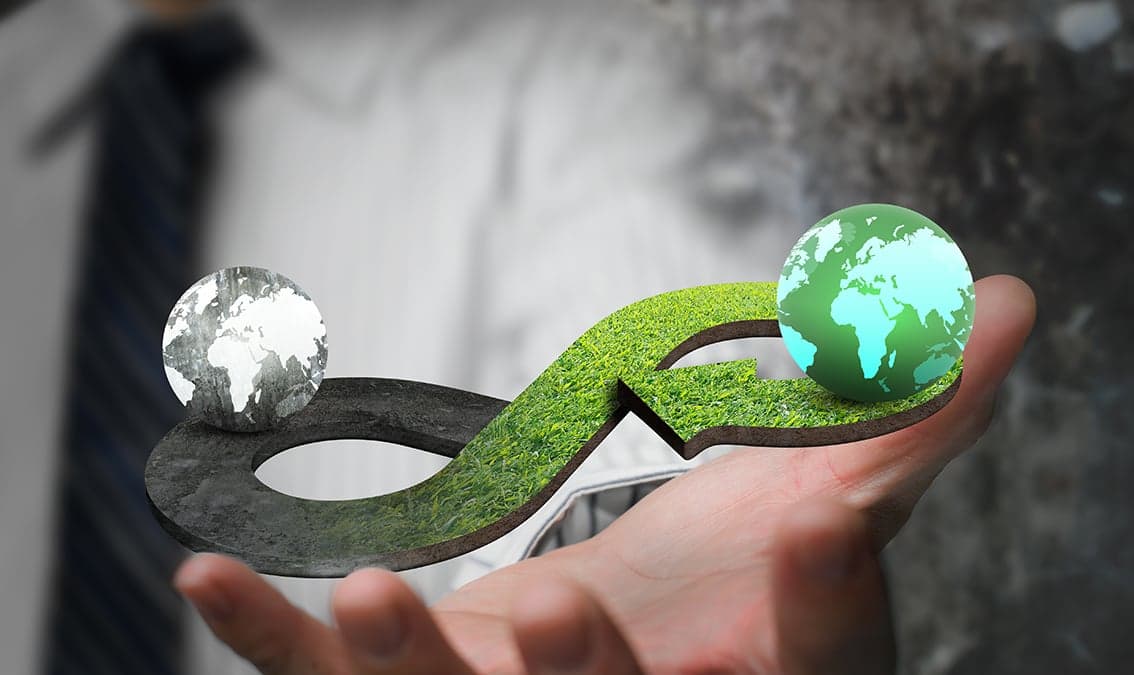
Do you want to contribute to a more sustainable society? Tackle the challenges in the transition towards a circular economy? In this course you will analyse what it takes to create a circular economy including sustainable supply chains. The transition towards a circular economy is one of the biggest challenges in order to create a more sustainable society. This transition requires circular thinking and an interdisciplinary approach, combining socio-technical, managerial, and environmental considerations. Right now we design products from cradle to grave: from production to consumption to waste, which is a linear model. But we should design products from cradle to cradle: in a closed loop whereby they don't become waste, but valuable resources again. And when we start thinking in circles, we might as well try to reinvent not just supply chains, but entire systems. Because that's what we have been doing with sustainability: we have been departing from the status quo, while cradle to cradle and circular pushes us to think outside the box. Cradle to Cradle celebrates abundance; it recognizes that people, just like ants and trees, are abundant and have a large impact on their environment. The challenge is to make this impact a positive one and we invite you to join this challenge! In the MOOC Circular Economy: An Interdisciplinary Approach, we therefore take a systems approach to the circular economy, considering different stakeholder perspectives, their incentive structures, and their impact on circular alternatives. The circular solutions will be assessed by using applied, as well as emerging, technologies. You will learn how to use life cycle assessment and agent-based modelling to assess the socio-technical and manageable challenges and environmental benefits of alternative solutions. Join the MicroMasters Program This MOOC is part of two MicroMasters Programs, Economics and Policies for a Circular Bio-Economy and Business and Operations for a Circular Bio-Economy . Both programmes prepare you for the transition from fossil to renewable, biobased resources and consist of 3 courses and a final project; the capstone: Economics and Policies in a Biobased Economy or Business Strategy and Operations in a Biobased Economy From Fossil Resources to Biomass: a Chemistry Perspective Capstone Economics and Policies for a Circular Bio-Economy or Capstone Business and Operations for a Circular Bio-Economy
What You'll Learn
- Understand the concept of a circular economy
- Understand how a circular economy deviates from the current linear system
- Analyse and develop complex circular systems using a systems thinking approach
- Assess the use of Life Cycle Assessment and Agent Based Modelling
- Formulate improvements for a transition towards a circular design
- Learn how to use and apply complexity aspects & agent-based modelling
Prerequisites
- To optimally learn in/from and complete the complete MicroMasters Program we expect you to have a bachelor degree in social sciences (preferably business-, or economics). However, there is no formal entry level requirement for this MOOC.
Instructors
Emiel Wubben
Associate Professor in Strategic Management
Alistair Beames
Post-Doctoral Researcher in the Operations Research and Logistics group
Gert Jan Hofstede
Professor at the Information Technology Group
Dr. Kim Poldner
Professor of Circular Business